
The Meaning of Love, Power, and Purpose
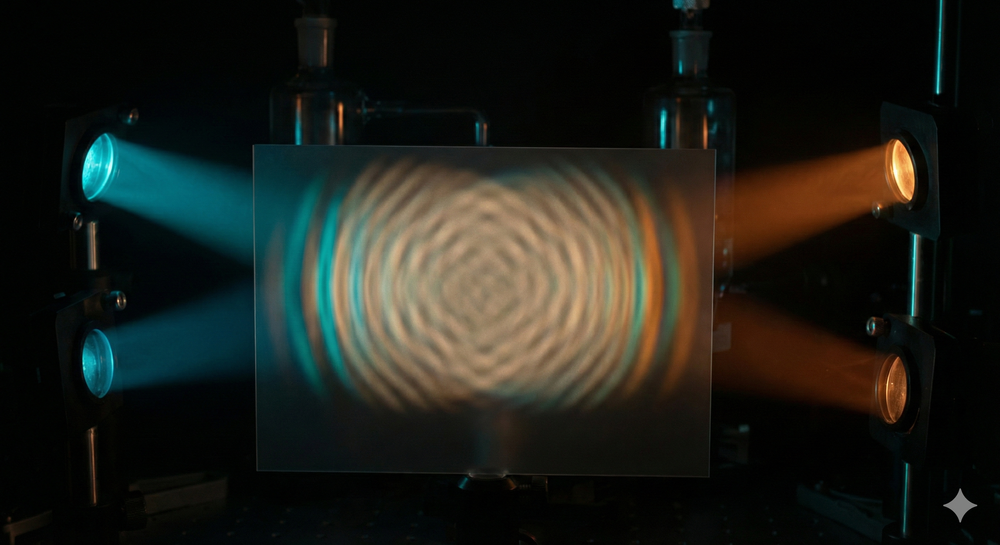
Love: intentional, vulnerable participation.
Power: forceful, silencing consumption.
The Core Principle
What would the unification of scientific discovery and spiritual significance do for the world? How does a religion, based as much in meaning as evidence, even work?
It's difficult to fully trust religions that exclude facts and theories in favor of faith and prophecy, while on the other hand, science doesn't seem equipped to validate our more divine human notions. Combining these conflicting viewpoints may appear impossible; however, the Novel Universe Model ties them together through the technical and spiritual implications of communication itself. Suppose that what creates human connection is the very same process that aligns our atoms. Suppose there's neither Heaven nor Hell, only the choice of how we relate to each other in life and beyond.
A Near-Death Experience on a daytime talk show provided the initial inspiration for this theory. On a late-night AM radio program, another man's NDE repeated key points with additional details. The man on television relayed his near demise on the operating table; on the radio, the man recalled having been struck by lightning. No matter the manner of death, both men had described a functionally identical "afterlife," in which they experienced the full effects of their actions on others. Not only was their independent confirmation compelling, but with deeper insights into the process, that initial inspiration would blossom into a coherent, ever-evolving model of science and religion — a genuine theory of everything.
During their Near Deaths, both men reported a "life review" from a previously unconsidered point of view. These men had returned to the tumultuous, disgusting, even violent behavior they'd inflicted upon others, only, in death's altered consciousness, the men were not simply replaying their own memories, or observing the scene from some passive, third-person perspective. In every detail, they were a kind of participant from a novel point of view, the grittiest point of view possible — the embodied first-person perspective of their victims.
In their stories, it was as if each man had been temporarily reincarnated as the "ripples" they'd had on others' lives — the abusive husbands became their abused wives. They experienced every previously unknown thought and feeling running through their spouse's mind and body — the emotional impact of a slur, lingering pain of being gaslit, physical sensation of an unexpected fist. All the abuse was known.
Spiritually speaking, what justice exists beyond a perpetrator reliving their victim's exact experience, a reward beyond knowing firsthand the feelings created by every act of kindness? This "Complete Information," exchanged between people after death, is not some divine force, but rather, a simple balancing of data — the full experience of what is true, no more, no less. If information is everything, "soul" is not some mystical energy or spiritual body, but simply an individual's unique pattern of preference — data — shared (or not) with others.
Each action is like a rock tossed into a giant river, casting Ripples that interact with the Ripples of other rocks — a growing ledger of interwoven, knock-on effects. For example, one aforementioned abusive husband experienced a Ripple during and after an argument with his wife — her storming out of the house, entering a nearby business, and verbally assaulting a person behind the counter. This husband bore, not only the direct effects as his miserable wife, but the subsequent series of knock-on effects his short temper had spawned — he next became the miserable store clerk, subject to a wife's unprovoked attack. By creating suffering in the world, he ultimately came to suffer that pain, and its disruptive spread throughout the universe.
What those men experienced in death was akin to unfiltered empathy. Their difficult truth, as unbearable as it was, became a framework that would forever change them. Both claimed in their interviews that they would never again abuse their wives, as they finally, fully grasped the consequences for their significant other, and ultimately, themselves. The men now knew violence does not move only in one direction — away — but directly back to them in the beyond-life.
Although impossible to fact-check these men's stories, the idea of an empathetic afterlife certainly impacts the believer's everyday, inspiring profound consideration for another's point of view. Unlike those religions that rely on their founding stories to be true — not necessarily logical or meaningful — the veracity of our story does not affect its inherent value, for the believer or society.
This distinction may sound subtle, but it's the difference between projection and empathy. Instead of doing unto others as you would do unto yourself, you do unto others as they would do unto themselves — true empathy, requiring theory of mind and occasional effort. This isn't selfish versus selfless, but good faith communication between perceived peers.
The core scientific premise at work in the Novel Universe Model is that everything is objectively data, and the somewhat quantifiable essence of our subjective experience of this data is known as qualia — the redness of red, how this one shade of color differs in value along the light spectrum from all others; but also, how its concrete hue is individually experienced between people.
Imagine the wonder of seeing red through another's eyes — the mundane, even disliked, is seen anew, seen as desirable, even inspirational.
It's qualia's novelty — its accumulation in life, and potential exchange between individuals in the beyond-life — that is the purpose of the universe. Our every experience of qualia is framed by either Love or Power — does one accept the idiosyncrasies of another's character as they choose to behave, warts and all, come to a full understanding of the other; or would one forego the unpredictability of others, and force an environment filled only with one's own preferences? Reality's raw facts (truth) constitute the framework of Love, a connection with each other based on a desire for Complete Information. Information Control, on the other hand, shapes the framework of Power, the stories we tell ourselves and others in order to manage our experience of information, regardless of what is true.
Love and Power aren't things, neither actions nor individuals, but points of view, frames of communication. We're always exercising either connection to or control over those around us, always rejecting, incorporating, or ignoring elements of the other, framed by either Love or Power. It doesn't matter if we are "conscious" of the process or not. Accepting that neither Love nor Power is inherently right or wrong, but that either better "fits" an individual or situation, is the first step in understanding each other, and the Novel Universe Model.
Love and Power
The fully empathetic afterlife of Love is represented in these men who came near death. They chose Complete Information, the intentional, vulnerable participation in the novelty of others. They'd begun to experience all that their Ripples had reached out to, for better or for worse. Power, however, makes a different kind of paradise. Often indifferent to others, Information Control curates a world of novelty through the forceful consumption of another's qualia. Theoretically, those men could have chosen not to experience every Ripple, but instead, cherry-picked from their earthly existence, reliving only those fonder memories of their wives. Instead, the men chose the suffering they'd spawned, accessing what awaits beyond their ability to fully imagine — their wife's authentic reality.
Does Love lead to "Heaven," while Power, to "Hell?" Neither is necessarily a reward nor a punishment, but a flexible, personal choice — what is one's Heaven might be another's Hell. The carnal Novel Universe is formed by mixing the two frameworks — all of us have acted out of Power, experienced Love; however, in death, the Mixture does not exist, leaving us to choose one or the other. Either we filter the data we've created on Earth, use Information Control to make an afterlife for ourselves that is isolated and under our jurisdiction; or, we accept the effects of all of our Ripples, and coexist with others in an afterlife filled with our collective, Complete Information.
Complete Information (Love) is not all possible information — that would be the Instrument. Love is the experience of what is real, what is true — one's unabridged exposure to all their co-created Ripples in the Concert Hall. Power, on the other hand, is not concerned with what is true, but with what is preferred — both their co-created Blocks on the global ledger, but also, any information, any desirable Block from anywhere — the Marketplace. The Marketplace isn't just fiction and fantasy, it's filled with stark truths, tantalizing lies, and beautiful nonsense. The opposite of truth, of Love, is not strictly a lie, but manipulation — Power.
In life, fiction can be effortless; without barriers, its construction is free to explore whatever one might imagine it to be. Truth, on the other hand, is concrete, often difficult and painful; with many barriers, its reality is defined by what it is and is not — there are no alternative facts, only reality. Truth — Love — is not merely data, but the precision of information, a scope of data that might never be fully known in a Novel Universe. Instead, our experience of truth is obscured by physics, biology, and ego — the messy flesh-suit that is the human body, active within its environment. Here, understanding another's experience of us will neither be complete nor accurate, but Love does Its best, while Power, often, could not care less. For Power, what makes a thing desirable is not a thing's objective truth, but the subjective value of its qualia.
What Happens in the Concert Hall?
What is the function of Love? How does Complete Information express itself in the Concert Hall — are all songs being equally heard? Does everyone know everything about everyone else?
In other words, does the choice of Love mean Linh will know every desire for and detail of all Dave's relationships, including Linh and beyond? No, not beyond, but in the Concert Hall, Linh will know everything that relates to their relationship, and subsequently, any shared Ripples with those others affected by the pair's interactions.
How far does the experience of truth extend in the Hall? With each of Linh's actions, Ripples proliferate throughout her social network. The potential for an individual to exercise freewill alters the initial salience one will experience of their subsequent Ripples in the Hall with each additional cause-and-effect link involved.
For instance, early morning one day, Linh gets a text from Felix, her coworker, that he'd heard their mutual friend, Dave, lied about her sexual orientation to her romantic interest, Dave's boss, Noa. She races over to Dave's house, bolts through the front door, and without preamble, punches him square in the face, before screaming incoherently and storming off in tears. Whether Dave lied or not, Linh's experience in the Hall of her violence will be the most salient possible — relived at the highest level of fidelity. She will experience that exact punch from Dave's exact point of view. This is not karma, punishment, or tit-for-tat, but Complete Information — the Ripples those men had experienced during their NDEs. Like them, Linh will fully know her abuse — the contact between nose and knuckles, spark of adrenaline, and thoughts of bewilderment rattling in Dave's brain.
Subsequent reactions from Linh's Ripple now race through the lives of others. Although Dave might forgive Linh, "letting it go" is difficult, requiring the effort of freewill. So, with some predictability, Dave, still feeling angry and betrayed, slaps his brother Sid for ruining breakfast — Sid forgot to put the milk in the fridge the night before. Sid, furious with the unjustified violence, tells his best friend Felix of the incident, but the moment Felix gently reminds him that Dave loves his cereal and this isn't the first gallon of milk Sid has spoiled this month, Sid shoves Felix and demands the "traitor" move out immediately.
Not one of these moments would otherwise have reached their emotional height without the driving force of Linh's initial violence (justified or not). Linh's portion of these causes means a corresponding portion of effects — with each new Ripple, the salience (qualia's experienced quality) diminishes. Linh may not feel the slap as clearly as Dave will, who actually slapped Sid, or as clearly as her initial punch to Dave, but like the man whose NDE took him to that store to account for his actions towards his wife, Linh, too, will embrace her chain of Ripples cast along her network of connections.
With each cause leading to a new effect, the portion of Linh's ownership for those second, third, fourth (and so on) sets of Ripples equally lessens, as each newly involved person has the freewill to either seek justice or forgiveness — the disruptive cycle either inflamed or diminished. As her Ripple compounds into a vast network of Ripples, involving more and more people, the number of connected experiences she'll have exponentially increases, but the salience decreases, eventually becoming mere data, like a massive set of reference material.
Consider these Ripples, passing from one level of contact in a network to the next, as a variety of ways to experience the performance of a play — the difference between being onstage, in the audience, or simply aware of the play's existence. The initial level with Linh hitting Dave would be firsthand — a performer onstage, embodied and visceral. With Dave slapping Sid, Linh's proportion would be secondhand — an audience member in the front row, passive, yet with an array of senses involved. Lastly, Sid shoving Felix, and Linh's experience would be indirect — reading a review of the play, where information, albeit sparse, is still being relayed.
What won't Linh know with Complete Information? Whatever has nothing to do with her. Complete Information is not all possible data, but instead, all related data. If Dave suffers a terrible fight with boss Noa, has the worst day of his life, Linh would never know of Noa and Dave's disturbing exchange unless she'd been there, Dave chooses to share it with her, or if the fight involved her in some way. If Noa joins the pair in the Concert Hall, Noa will learn firsthand what he did to Dave, come to fully empathize with his former employee.
What Happens with Power?
What is the function of Power, of silencing Ripples Linh has no desire for? If Complete Information is the truth, is Information Control a lie? Information Control is more than that — it's manipulation, curation. With Information Control, Linh doesn't have to know what that punch felt like unless she wants to. Linh could choose to experience only Dave's adrenaline, or feeling of confusion — whatever personally interests her. And those subsequent knock-on effects? They become a menu to be dined upon at her leisure. So, when we die, if we don't want to experience the full weight of our actions toward others, stay out of the Concert Hall, and choose Power.
If Love is able to create unlimited novelty, then what would motivate anyone to enter a universe shaped by and subject to Power? In the "heaven" of Love, Linh always knows exactly what Dave thinks about her — no misunderstandings, no lies — and should she hit Dave in the face, she'd simultaneously suffer the experience. Although in the Hall her understanding of others is comprehensive, perhaps it isn't worth it — perhaps she doesn't want to know all of her Ripples. In the case of a person like Hitler, it would take an act of unusual resilience to know the sum of his actions on Earth, and perhaps he has understandably chosen to stay separate, confined to an isolated existence.
Although we might experience Love at any point in our lives, we must all exercise Power — one forcefully consumes air, food, and information to survive. For most of us on Earth, we embrace both, wandering moment-by-moment between Love and Power, experimenting with our options, and slowly coming to understand which frame best suits us.
It may seem obvious which framework to choose. The information available to Love is also available to Power, and furthermore, Power can forego the "punishment of sin" and filter what It's exposed to. Why would two abusive men choose Love in their near-deaths? Because it's not just about access, but Love's inherent ability to generate limitless novelty and more. After enduring the intensity this messy body imposes upon us, suffering provides additional value — not in making sense of nor placing blame for the suffering, but instead, in developing connections. In the Concert Hall, we share all of our joy and our pain — we build an afterlife on a foundation of kinship, where novelty explodes. It is only through suffering that we might know those poignant moments of forgiveness, reunion, healing, and so much more. It is also in the sharing of our common sufferings that we discover deeper connections with those who know our pain in ways no other can.
What's the benefit of the framework of Love? In "heaven," we will not be alone. Through Complete Information, all Sets who return to the Concert Hall exist together, allowing for effortless, exponential novelty. But there's a "cost." To enter the Concert Hall, we first will suffer and rejoice in Complete Information — the true justice and reward of all the Ripples our actions and reactions created on Earth.
What's the benefit of the framework of Power? Through Information Control, we don't have to be exposed to anything we don't want. In this "heaven" there's no permanent line of communication, and we're all alone — absolute freedom. But Power is more than just controlling Ripples; It's forceful consumption of any information we desire.
Our Spiral and the Marketplace
The Novel Universe, unlike the beyond-life, is filled with all kinds of barriers, both knowable and unknowable. From the outside, we can "read" another's body language, tone of voice, and verbal communication. With experience and wisdom, we might glean some idea of what's going on inside, but deciphering the truth of another's point of view and intent will always be flawed — even a full understanding of our own motivations can be challenging. Complete Information and Information Control are only accessible beyond the physical body in an afterlife (Concert Hall, Spiral, or Marketplace) where all barriers are both knowable and known, existing as inherent properties of the frameworks. As we choose our "heaven," we choose both our limitations and our opportunities.
Before the "tunnel of light," Near-Death Experiencers commonly report finding themselves in darkness, a void. Many feel an overwhelming sense of peace, while a few recall sheer terror, but, at least in the beginning, the experience is seemingly devoid of others. So, where is this first, disconnected place that we all go? We call it our "Spiral" — a universe of our own making, where we whirlpool into ourselves, and disappear from everyone and everything. This is the "no-where," akin to the Instrument's unplayed note.
Unless or until we pick our "heaven" (travel this "tunnel of light" to the Marketplace or Concert Hall), we can remain in our Spiral for as long as we wish. There's no higher power imprisoning us; we are our own Prime Mover of reality, and may fill it with our history, preferences, imagination, or simply turn the lights out, and experience nothing, forever. But that's the catch. The cost of Power is that this universe is our dream, and our dream alone.
If Linh chooses Power and Dave chooses Love, then when Linh sees the specter of Dave in her Spiral, he's no more real for Linh than a cat in a video is physically inside the device. What she's seeing results from the limited information about Dave recorded in her Signature-Frequency Set — her end of the Ripples between them. Linh can take this data — this avatar of Dave — and tinker with it, imagining what it might be like for Dave to entertain her. However, the reality of Dave's actual behavior is beyond Linh — we're all capable of unimaginable things.
Like a kid having played a video game too many times, Dave's avatar eventually bores Linh. At this point, she has a few choices: account for her Ripples (Complete Information), return to the Concert Hall, and reunite with Dave; or abandon Dave's memory altogether. But should Linh want her cake and eat it too, she'll open her Spiral to a "network connection," and head for the Marketplace, where she might find those in the office that day willing to sell her their novel perspectives on that fight between Dave and boss Noa. Thus, she not only gets to experience that fight from the acquired POV, but her avatar of Dave evolves with an infusion of data, making future use of his character more likely, if not more entertaining.
The Marketplace is a network of information exchange. In the Concert Hall, the global ledger is unfiltered, every note shared without suppression or alteration — all who are connected know all that connects them. The Marketplace, on the other hand, is an assembled evolution of the Instrument's ledger — deliberate, narrow connections forming trading routes of specific information, specific novelty.
Just as the salience of Ripples decreases in the Concert Hall with each new step of cause-and-effect, the clarity of our network connection with another in the Marketplace also depends on the totality of Ripples accounted for. Should Linh and Dave account for a handful of shared experiences, their network connection will be akin to exchanging emails about a play. With many Ripples accounted for, the connection strengthens, now sharing information like a one-man show to a seated audience member. A complete connection, where the pair experiences all the Ripples between them, places each onstage, able to fully experience the other's data.
In her own Spiral, Linh is the capstone of an informational pyramid. However, available data is limited to what she'd personally gained by living any number of lives, and what her imagination is capable of doing with it all. Eventually suffering a lack of novelty, Linh enters the Marketplace, where Information Control bridges the Spirals of independent Sets for the purpose of buying and selling data. She forgoes interacting with undesirable information, and trades her valuable data for what she wants. The very concept of economics, of managing resource and surplus, is Power's Earthly expression of the Marketplace.
The Tower and the Square
Power, Itself, is binary: the hierarchical Tower, where decisions are top-down from management to labor; and the illuminated town Square, where decisions are deliberated between actors of quasi-equal standing. Power is the mechanism of force in conflict, and thus dichotomies arise — master and slave, male and female, chaos and regulation. The very concept of "opposites" is a construct of Power — monotheism denouncing polytheism; labor organizing against management; individual rights breaking free from collective security. Which Power structure is "good" or "bad" depends on an individual's view of their environment.
In a hierarchy of Power, valuable information flows from subordinate to superior, and the superior distributes or withholds this "treasure" as reward or punishment — the hierarchy's currency and mechanism of control. The patriarchal god atop the Tower protects resources from outsiders, and provides unparalleled profits for his people, who need not search out variety on their own. Underlings may not engage the Marketplace directly in trade, but instead, act as a Tower's workforce, rapidly accumulating novelty through the machinery of hierarchical management. The Tower's pyramid of control is akin to the economics of capitalism and the political structure of autocracy.
In an illuminated town Square, everyone is their own god, a single level of control akin to the economics of socialism or the political structure of democracy. They exclude outsiders, trading prized information among initiates. Through the revelation and practice of Gnosis, they're master merchants, freely exchanging tantalizing truths and entertaining lies, independent contractors beholden only to themselves and each other. On average, variety is generally harder to come by through the Square than it is through the Tower's vast reserves, but the masses of the Square aren't stuck with the boss' table scraps, instead, having the freedom to pursue their deepest desires on their own terms.
Not everyone in every Spiral is part of either network. It is the nature of Power that one has full control of their universe, and anyone might be a Marketplace freelancer. Additionally, there are some who simply wish to be left alone in their Spiral, and forever dream a fantasy of their own making. Furthermore, for those who want it all to end — to vanish into nothingness — they can, through Power's absolute Information Control, have this version of heaven — a state of pure silence akin to the Instrument's unplayed note, where time, space, and preference ceases to exist.
The Nature of the Frameworks
Is Power evil, and Love good? The very premise of good and evil itself is a vestige of Power, not to be conflated with the other framework — "God is love" or "the power of love" are contradictions in terms. Love is neither a person nor thing but a perception, connecting participants through authentic communication. One who practices Love, vulnerably participates in their Ripples; one who practices Power, controls Ripples. For Love, right and wrong do not exist, nor do missions, dogma, or agendas.
Love is not a system of any kind, just the intention of fostering connections through authentic communication — what is true. Power swings its pendulum of opposing extremes through manipulative communication to extract novelty — what is desired — convincing us one thing is right, and the other is wrong. The moment someone states with conviction, "this is right," or "this is what to do," they speak the words of Power. The moment someone asks with compassion, "what do you think," or "how do you feel," they speak the words of Love.
Love integrates Its participation, creating novelty, while suffering Power. In the process, Power forces Its consumption of Love's novelty, and the living cosmos unfolds through Their Mixture.
Co-Created
The "Instrument" of consciousness in the beyond-life is as a piano, infinite in scale, yet each key, a finite pitch with infinite precision. One of these keys is unique to Linh and no other, while Greg, too, has his own special key. Linh sings her single note, Greg sings his. Together, they co-create a unique chord within the Concert Hall — a common space where all notes are open to commingle. This choice to share their notes (or not) creates the pair's novel sound — a Ripple of their interaction.
By expressing preference — either ignoring, incorporating, or inhibiting Greg's special note — Linh develops her history. She becomes more than her initial key on that piano, but additionally, her reaction to that chord. With further Ripples, Linh "assembles" into an informational symphony. This symphony — all of Linh's reactions and relationships accumulated over eternity — is her Signature-Frequency Set (SFS). Think of it as an ever-evolving fingerprint of consciousness. No two are alike, and none are ever finished. Although an SFS has a finite history, each eternal relationship is an infinite possibility of shared complexity.
Ripples are interactions between Signature-Frequency Sets — information exchanges, momentary combinations, new chords — and result in a constant state of evaluation, a gradient of reaction: accepting, rejecting, or disregarding the unique characteristics of another. The evaluation itself is not a reflection of moral bias — not a choice of Love or Power — but simply a reaction to specific qualia. Acquisition of data doesn't necessarily indicate Love, nor rejection necessarily indicate Power.
Within the Concert Hall, Complete Information is a chorus — an activity where we are both fully expressing ourselves, while simultaneously, fully comprehending those others. In mortal life, we are limited to either speaking or listening — we cannot do both simultaneously while maintaining effective focus. In the Hall, however, Complete Information's perfect circuit means we cannot do either in isolation. This ability lies beyond direct human comprehension. It's fully integrated communication from both ends — interwoven viewpoints without the constraints of timing, translation, flawed information, or other such barriers.
The potential number of persuasive narratives — spiritual ideologies, scientific theories, social norms — is without limit, and figuring out the universe's "correct" meaning neither helps nor hinders our Set's eternal development. What truly matters is how we perceive and communicate with each other, and how the process evolves through the frameworks of Love or Power.
The Prime Mover
The question of the "Prime Mover," or what Aristotle called the "unmoved mover," asks something like: "If the universe created me, and God created the universe, then who created God?" Going backwards along this line of thought eventually leads to a paradox — a reaction without inciting action, God as zero. The Big Bang Theory, similarly, seeks to describe the universe's origin but cannot identify the exact circumstances before Inflation — its random beginning from essentially nothing.
Does the existence of a universe necessarily require a beginning or divine creator? Suppose not. Suppose the universe is a tool — purposeful, assembled data for novelty extraction — and Linh, no more than her history as a dataset, a never-before-known pattern, leading back to her singular note. Data's always being exchanged, and always will be. There's infinite novelty in the way Linh creates that history, how she adopts, rejects, or ignores the voices of others, and it all depends on her personal preference.
The Instrument exists beyond the cosmos, beyond time — the potential for any and all possible data sharing, neither God nor individual, but numbers, independent of personal or divine desire. No Creator, no "heavenly plan," no path of enlightenment is required. There is only communication — the inherent exchange of information between Signature-Frequency Sets within the Instrument's global ledger — an interwoven record of all Ripples between all Sets.
By engaging with and evaluating the information in these very words, we, together, are casting Ripples to enhance our Sets. In death, we'll not only know the other's experience as they read or wrote this, but any future Ripples these interactions might generate. Soulmates? Best friends? Those early combinations with other Sets had profound effects on the assembly of our SFS. We "vibe" with certain people because their voices are rooted deep in our dataset, foundational to who we are — the way a painter might favor a certain color in their art because of the hue of their childhood home. Built through every interaction we've ever had, our Signature-Frequency Sets are a kind of eternal "DNA," in that they store functional data, built from our experience of others. They are the stories, blueprints, and factories that construct those reactions best predicted to fit our environment, and maintain our preferences.
Consciousness at Every Scale
Under the understanding of panpsychism, everything is conscious, from atom to organism, and keeps to itself its own history, as part of the Instrument's global ledger. After Linh shared her single note with Greg, she first became a chord, and eventually, a symphony — a complex dataset developed enough to operate a human body. Like Linh, all of our choices to interact (accepting, rejecting, or simply brushing off Ripples) co-creates each one of us, every second of every day. These choices are a product of our history, framework (Love or Power), personal preferences, and freewill — our capacity to change those preferences.
Sets are in constant flux, eternally evolving through their interactions with other Sets. Malcolm, the "cool kid" at school, is seen smoking, so Dave adopts that Ripple — casually sparking a cigarette for himself. Conversely, Linh eyes a bitter rival wearing Linh's same style of hat, so she rejects the Ripple — immediately stuffing the headgear into her locker. Of course, most Ripples are brushed off, that array of personalities passing without notice every day.
Freewill and Effort
Determinism proposes a one-to-one relationship between cause and effect — from the beginning forward, what has happened "determines" what's next. If Linh's conditions are known — her epigenetics, stressors, body chemistry — freewill is no more than an illusion. The Novel Universe Model suggests otherwise: Linh's life is not predetermined, but the highly variable answer to a single question — at this moment, does she adopt the framework of Love or Power?
Effort is the key signal of freewill's presence. Effort, by its very nature, is exertion against what's "easy" or expected. Although most mostly march to the drumbeat of social cues and biology, sometimes some simply will not. When novelty is expressed in the universe, things appear random, as underlying freedoms are revealed through the intentional interaction of individuals.
Despite biology directing various actions to varying degrees, our freewill to see the world in terms of Love or Power sets forth the scope of our options, whether determinate or malleable. Freewill can be a moment of tepid hesitation, an intense second of rushing in, even a profound epiphany — those times we flip frameworks, suddenly seizing control with silencing force, or relinquishing control with intentional vulnerability.
The action of choice — the expression of freewill — created each and every one of us. From the moment we developed our single note into a chord by way of our initial interaction with that other, we became our own Prime Mover. Understanding that we created ourselves through the act of communication — a perpetual act that continues to this day — encourages us to truly embrace the fullness of our being without excuses or limits.
The theist believes in God; the atheist, determinism. The functional difference? None. Either perspective believes that there's no choice, no chance to change what will be. The Novel Universe Model, instead, supposes that choice spawns novelty from the interplay of individuals: the conscious expression of preference and freewill constructs reality through the narrow observation of and reaction to the actions of others. Instead of the universe being predetermined by a Creator or laws of Nature, it is a co-creation of the chaotic Co-Created, evolving our collective Ripples together.
The Purpose of the Novel Universe
The Novel Universe Model uses a metaphor of "the River" to describe the Novel Universe and its Mixture of Love and Power. A river, as a concept, is a single emergent "entity," built of two different states of matter — a solid base (riverbed), and a liquid body (water). In NUM, Love, as Water, temporarily flows through the more permanent structure of Power, as Rocks. Power provides the form of the Novel Universe, and Love, the motion.
It's only when we disturb a stream of water that it's possible to know how fast it flows. A disturbance generates waves unique to the shape of the disturbance. The Marketplace reflects the Riverbed, each of its networked, isolated Spirals a Rock of the Riverbed. The integrated Concert Hall reflects the Water, its population an integrated whole. Through the motion of Love, churning across the banks of Power, waveforms of interaction create bubbles — the quantum foam of spacetime — and thus the River of the Novel Universe emerges from these mutually exclusive frameworks: integration (Complete Information) and isolation (Information Control).
The physical universe's creative force cannot be Love or Power alone. Only Love has the connectivity to be the River's Water — a body of infinite parts, bound as one — and only Power might shape the River's flow — a foundation of disturbances, constructed of independent Rocks. Power's force keeps the Water flowing through the Rock's assembly of shapes, shapes interesting enough to maintain Love's participation.
The River is an informational structure, akin to a simulation, but not a construct of something that otherwise exists. Like any simulation, the River is an illusion with a purpose, and to make use of it, designed like a perpetual dream, intentionally secluding us in the dark of the dream's limited memory and awareness. Separate from the Concert Hall and Marketplace, the River enforces a case of flesh-covered spiritual amnesia. How else could we take the simulation seriously if we otherwise knew things that appeared permanent — things like loss and death — were ultimately illusions?
Once inside, the Mixture is all we might know or perceive, as each "life" is expressed as the River's transitory foam, created by the River's disruptive shapes. Like foam, it all eventually dissolves away (entropy), only to be replaced by more foam, evolving into more interesting shapes, shapes geared to express the universe's primary function as a novelty engine.
The Disguise of Power
For those of Power, the "mission in life" is to find treasure, obey a master, learn valuable secrets, or otherwise "win" the game. Hoarding rare experiences is guaranteed to provide a vivid, isolated afterlife. Power exploits, obsesses over status, enforces solitude.
Great stigma is often associated with many of Power's core characteristics, such as being uncaring, greedy, or domineering. To thrive in a world so full of actors aligned with the framework of Love, Power has necessarily disguised Itself as Love-adjacent, transmuting these "vices" into respected "ideals" — strength of character, independence of thought, freedom of speech, sovereignty of action. Though they appear benign, even laudable, these ideals can become a slippery slope. How far is the strength of character from bullying, independence of thought from bigotry, freedom of speech from harassment, or sovereignty of action from abuse?
By cloaking itself in this costume of Love, Power has completely captured the world's imagination and administration. This conflation has created instability and imbalance at a global scale — no one is socially punished for "helping" (Love) the needy, but often derided for not "fighting" (Power) for those very same people's rights.
The Novel Universe Cult's mission is to change this by chipping away at the stigma, providing license to those who would choose Power to do so openly, ideally never feeling shame (external stigma) nor guilt (internal stigma). Until those of Power might confidently express their choice without social or emotional cost, we'll never find balance, never solve the larger issues that stem from this conflation.
Why We Come Here
The great irony of Love is that Its most valued tools tend to show up in the ugliest spots on Earth. We fill our stories full of tragic heroes, found families, dystopian apocalypses. Who wants to watch a movie where everything goes according to plan? A great ending is when struggle is overcome, not when the masking tape predictably peels from the wall without a blemish to the paint. As in life, moving stories are the great songs sung in the Concert Hall — more than Power's variety of entertainments, but Love's bridges that deepen connections.
Consider Dave in the Concert Hall, who loved so purely, that when he arrived in the Novel Universe, he had to completely lose Love's framing in order to experience a more complex emotion, like the righteous indignation required for a hero to become a monster — it's not possible to become a monster if one always participates with intentional vulnerability.
Having repeatedly enjoyed a play in the Concert Hall — a story of rage, regret, and redemption — Dave yearned to leave his seat in the audience to become the actor on stage. That story of redemption resonated with Dave, but he'd never experienced such a regret, never known a single moment of rage — Dave had no idea what Earth had in store for him! Willing to undergo reality's inherent amnesia, Dave enters the River because he desires the spiritual tools he'd observed wielded in the beyond-life, yet does not possess himself.
Now blind to Love, Dave navigates a life designed to make certain "mistakes" more likely. The inevitable goal of this self-imposed predestiny being that, upon his return to the Hall, Dave might perform this particular story, creating novelty for himself and his audience with a beautiful characterization of these deep emotions and complex feelings. On the other hand, if he discovers "enlightenment" too soon — never making those mistakes — he might find himself back on Earth for round two, hoping once more to make those valuable mistakes in order to finally know those valuable points of view. Then again, Dave may realize, after that first go-around, the cost is too high, and simply stay in his seat, better able to appreciate the work it takes to live those difficult lives that create such complex, amazing characters in the Hall.
The biggest jerks on Earth, should they desire Love in the beyond-life, potentially have the most to learn from the suffering in their wake. For Love, existence isn't designed to find the path, obey the master, or secure the pot of gold at the rainbow's end. Self-realization, like any reward, is a ruse perpetuated by Power to gain compliance with Its narrative. We've come here to intentionally stumble around in the dark. Whether in the Concert Hall or Marketplace, we're more enlightened and self-realized there than any level we might reach here, where we lurch in our flesh-covered meat-suits from one embodied tendency to another. So, as long as we believe "the answers are out there," and it's our personal responsibility to find them, we're subject to Power's manipulation — the idea that someone other than ourselves might have a more solid answer. But that's impossible — it's the very state of our preference that's in question.
Entering the Marketplace's network of siloed nodes is a world where there are no free agents in one's Spiral besides oneself, where Information Control means we are either experiencing our memory, replaying some acquired memory, or imagining some self-constructed variation. Entering the Concert Hall's shared reality is a world of co-creative interaction, where Complete Information means that there is no hidden thought, no deception, no suffering kept secret.
Like access to the Instrument, solitude is inherent to all Signature-Frequency Sets regardless of their choice of "heaven." We can always seclude ourselves in our Spiral, even if we've chosen the Concert Hall. Furthermore, those of Power can change their minds, and, through the process of Complete Information, leave their Spiral at any time to join the others.
To see Power as "evil" and Love as "good" completely misses the point. Good and evil are both standards of control. Love is uncontrollable — neither strong nor weak, selfish nor selfless. Love is compassion, consideration, connection. Power means someone's always excluded, silenced; with the selfish or selfless, someone's always being left out. Love participates in suffering, dignifies everyone present without judgment, punishment, or retaliation.
The Mixture's purpose is to ask, how will we produce novelty? Participate, and experience others as they truly are, or manipulate, and experience a curated variety of those others? There is no correct answer; life is neither a war of the Square nor test of the Tower. We aren't required to come to a conclusion, and can always change our mind.
This message of Love and Power is not a missionary that can claim to save our souls, nor is the conversation complete. Being alive means that, through our personal preference, we daily exercise both Love and Power. No matter the tally of our choices, we take everything with us, our complete Signature-Frequency Set. The purpose of life, as defined by the Novel Universe Model, is to evolve our unique pattern of information, while researching what "heaven" means in the only laboratory where Love and Power coexist — the Novel Universe.
For the Theory of Everything — the technical and scientific grounding of the Novel Universe Model — Theory of Everything.
For the NUC Creed — the constitutional framework of the Novel Universe Cult — see the Creed.