
What Happens When You Die
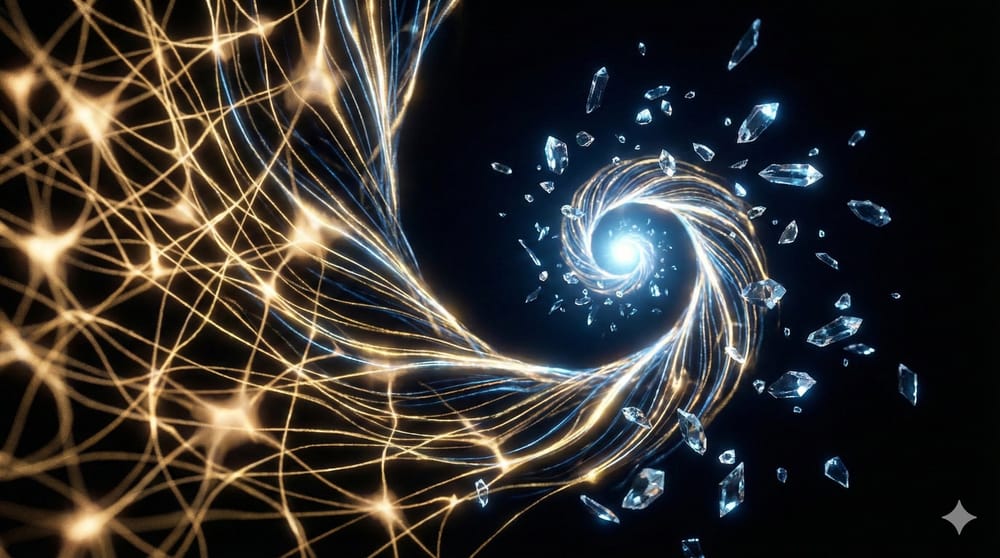
You die. And then — according to the Novel Universe Model — you meet yourself.
Not the version of yourself you've been performing for others. Not the curated highlight reel you've constructed as identity. The real thing. Every Ripple you've ever created, every action and its consequences, laid bare without the filters of biology, ego, or time.
But first, the void.
Near-death experiencers frequently describe the same initial stage: everything disappears. No body, no light, no others. Just you, alone, in a darkness that feels less like emptiness and more like a cocoon. Some report peace. Others report terror. But the consistent thread is isolation — a sudden, total disconnection from everything and everyone.
In the Novel Universe Model, this place has a name. It's your Spiral — a universe of your own making, where you are the sole creator of reality. Think of it as your personal dataset: everything you've experienced, remembered, and imagined, swirling inward like a whirlpool. No one is imprisoning you there. You're simply... alone with the full contents of yourself.
This is where the choice begins.
You can stay in your Spiral. You can replay your favorite memories, construct elaborate fantasies, build an internal reality from the raw material of your life. The catch is that all of it comes from you. The people in your Spiral aren't real — they're reconstructions based on the limited information your end of the Ripples recorded. Like a video game played too many times, eventually even the best memories lose their novelty. Your friend's avatar does what you expect. Your spouse's character says what you'd predict. The spontaneity that made those relationships alive is missing, because spontaneity requires an actual other.
When the isolation grows stale, you have options. You can enter the Marketplace — a vast network where isolated souls trade information. That memory of dunking a basketball? Someone will trade you a memory of climbing Everest for it. The Marketplace is Power's afterlife economy: curated, controlled, transactional. You never have to be vulnerable, but you also never get the real thing — just data, exchanged at arm's length from behind the security of your Spiral.
Or you can enter the Concert Hall.
The Concert Hall is Love's afterlife. Complete Information. No filters. No hiding. Every Ripple you've ever created comes back to you at full fidelity — not just your experience, but theirs. The person you helped feels the help. The person you hurt feels the hurt. You become, momentarily, every person your actions ever touched, experiencing their reality as they lived it.
This sounds like heaven or hell depending on the life you've lived. And that's the point. The Concert Hall isn't a reward or a punishment — it's a reckoning. A complete accounting of what your existence actually meant to others. The abusive husband who near-death experienced his wife's pain wasn't being tortured by a divine judge. He was simply receiving the full dataset of his own actions, unfiltered.
After the reckoning, the Concert Hall becomes something extraordinary: a shared space where every connected being participates in each other's reality with total transparency. No miscommunication. No deception. No loneliness. The novelty generated by deeply integrated relationships — relationships without barriers — is exponential and endless.
Here's what the Novel Universe Model doesn't do: it doesn't tell you which afterlife to choose. Power isn't hell. Love isn't heaven. They're frameworks, and the right one depends on who you are. What the Model does say is that the choice is yours, it's permanent, and it defines the nature of your eternity.
So. What happens when you die?
You meet the consequences of every choice you ever made. And then you choose one more time.